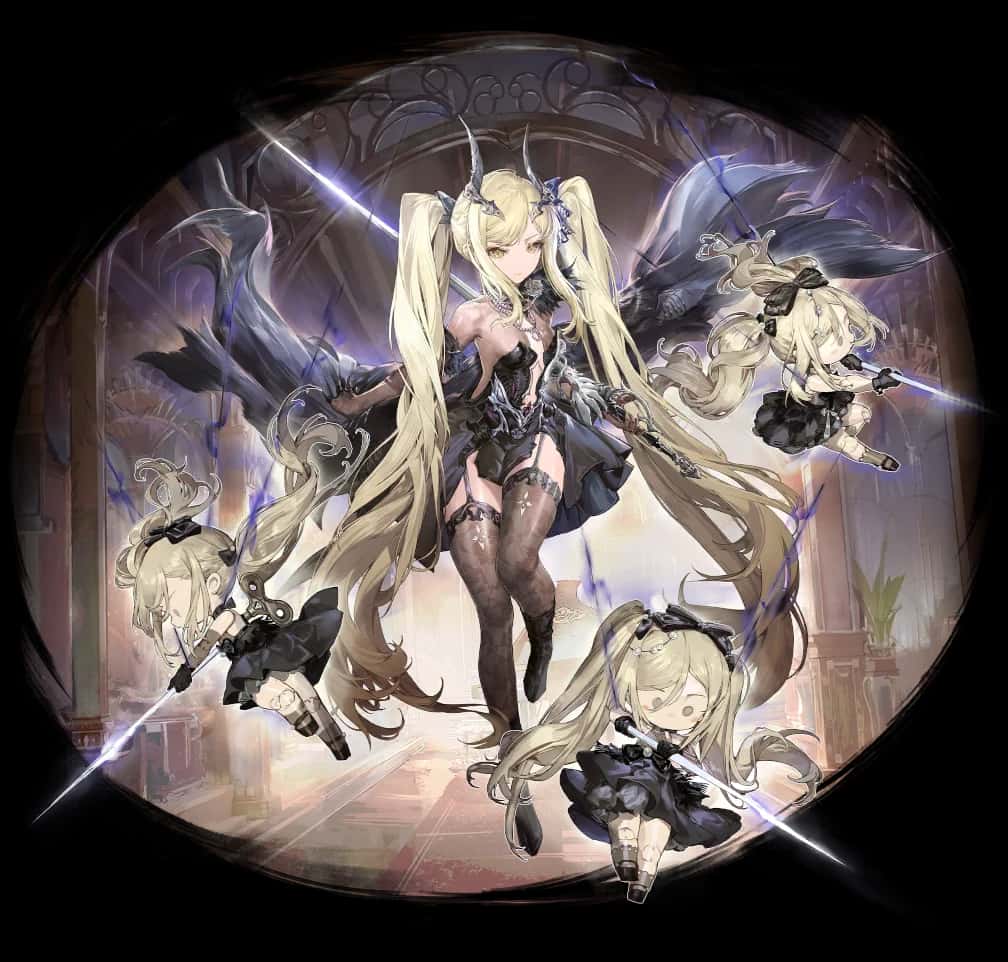






Flora
 5-star/Umbro/Sword / Assault Rifle
Introduction
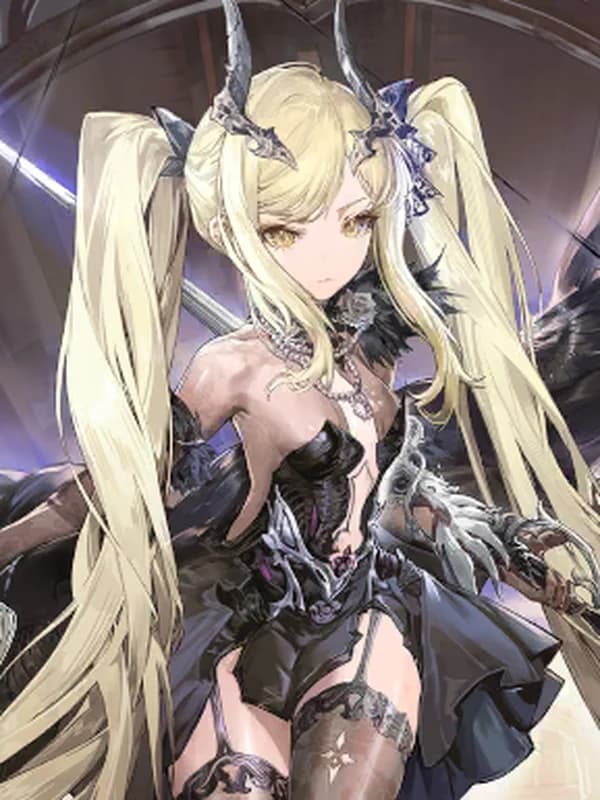
Flora is a 5-star Umbro character in Duet Night Abyss. Flora's weapon type is Sword / Assault Rifle and role is DPS. Affiliation: The Hyperborean Royal Family.
Other Umbro characters in Duet Night Abyss: Berenica, Phantasio and Vita (Umbro).
Profile
Flora carries the title "Mutinous Inflorescence". Flora's birthday is April 28. Flora is voiced by Liu Wen in Chinese, Rachel Hurd-Wood in English, 原由実 in Japanese, and 김가령 in Korean.
Stories
20Witness: Ⅰ
At first, Flora struck you as proud and aloof. One indifferent glance from the Overseer of the 13th Legion was enough to decide who would live and who would die.
Only later did you realise she had not always been that way. She had learned to wear coldness like a second skin, because the life she had known left no room for closeness or sincerity.
Anecdote: Ⅰ
The Cornelli estate stood out on the plain. Countess Margareta Cornelli was well past fifty. Grey had begun to thread her hair, and her back no longer held the straightness it had in youth. Every afternoon, she had a maid bring her a pot of flower tea and a plate of scones, then sat beneath an old willow in the garden with her needlework. The children from the nearby village loved her garden, and they loved her too. Towards evening, when the worst of the day's summer heat had begun to ease, they would come running over in twos and threes, chasing one another through the flowers and tumbling across the lawn. Sometimes, after all their running about, they would settle at last around the Countess's wicker chair, casting longing looks at the scones on the table beside her. She would smile and give a small nod, and at once they would reach for them in delight, cheeks round with crumbs as they ate.
One day, the boldest of them asked, "Ma'am, is it true you once served Princess Flodia in the Imperial Palace in Dismania?" He looked up at her and added, "Would you tell me about her? They say Her Highness used to reap wheat with a golden sickle."
The Countess paused over her sewing. She did not laugh at the child's innocence. Instead, her gaze drifted over their heads towards the distant horizon. She remained silent so long that the children began to grow restless with boredom. At last, she set down her needlework and said, as calmly as ever:
"Princess Flodia does not reap wheat. She is a bird kept in a cage, and caged birds never reach the wheat fields."
Secret: Ⅰ
When Flora was eight, she once tried to "escape" the palace. One day, she noticed that the gardener had forgotten to lock the gate. That night, once the moon was up, she slipped quietly down from the tower and ran to the iron gate at the far end of the courtyard. It was tall and adorned with sculpted roses, beautiful, but impossibly heavy. She pushed, but it did not budge. She beat at it until her palms turned red, but still it would not open. Not far away, the guards stood rigid at their posts. Bound by duty, they did not so much as glance at the young princess.
In that moment, she understood: she would never be able to open that gate, whether it was locked or not.
Reminiscence: Ⅰ
When I was very young, there was always a thick book on my shelf: The Fairy Tales of Atlasia. It was a collection of folktales and legends from all over the world, gathered by a travelling linguist. Over the years, I read it so often that the pages grew worn. In those stories, the heroine was almost always a princess, living a life both vivid and extraordinary: sailing the open sea, wandering through enchanted realms, outwitting danger, and using magic to bring happiness to others. I, too, was a princess. Back then, I believed with all my heart that those stories promised me my own future, that one day, I would live such a life myself. But as I grew older and began to understand the world, I came to realise that such a future would never be mine. It had never been meant for me. From then on, I kept the book on the highest shelf, out of reach, and never dared open it again.
My life was suffocatingly monotonous. Every morning, when the bell struck seven, the chief lady-in-waiting would draw back the curtains with unfailing punctuality. Sunlight flooded the room, gilding the drapes in my chamber. Two maids would dress me, lacing my corset tighter and tighter until it bit into my ribs. My breath caught. My chest ached. I wanted to cry out, but in the end the cry never came. All that remained were the faintest curve at the corner of my lips and a "Thank you."
The maids stood in neat rows like an honour guard. At the long table, I ate breakfast alone in silence. Then came the long, airless day. I would sit at my desk with some dense volume of philosophy open before me, yet never truly lose myself in it. Perhaps this one is too obscure, I would think, closing the book at last. Then I would try a novel said to be all the rage among the young ladies of the capital. But my eyes never stayed on the page. They drifted instead to the terrace garden beyond the window. It was kept with meticulous care. Each tulip had been wired upright, every bloom held aloft, every bed arranged in perfect rows by colour. How pitiful, I would think. In this beautiful gilded palace, even the flowers were made to bloom as human beings wished.
By now, perhaps even this account has begun to weary you. That would only be natural. The first half of my life was scarcely worth recounting. In any proper story, it would hardly fill a page. Other young noblewomen, caged like songbirds though they were, at least had afternoon teas, salons, and balls to attend. I, however, was permitted to leave my quarters only on major feast days and formal occasions, just often enough to be seen, and to assure the public that Princess Flodia had not, as rumour claimed, been quietly murdered.
Though I bore the highest title of any noblewoman in the realm, I knew well enough that it won me no welcome among the nobility. As a child, I looked forward to every grand occasion, for it meant I could leave my tower and meet new people. But in time I came to understand that they did not look forward to seeing me. The noblewomen invited to the Imperial Palace would gather at the edge of the ballroom, their fans swaying lightly as they spoke of the latest fashions, their children's marriages, the rain in Dismania. Their laughter was soft and close-woven, like the cheerful hum of bees in a garden. But the moment I gathered up my skirts and ran towards them, hoping to join them, the laughter would cease. At once, the air would tighten into something awkward, sometimes even touched with fear. Then, as though by silent agreement, their faces would settle into smiles meant for courtesy alone, never warmth. They would curtsey with perfect grace, avoid my eyes, and murmur that they must excuse themselves, as urgent matters required their attention.
At the time, I did not understand why they avoided me. I stood before the mirror time and again, asking myself the same questions. Was I like the villains in those fairy tales, the ones everyone despised? Was I too foolish to be loved? Or was I simply so ugly that people recoiled at the sight of me? Then one day, as I stood asking myself those very questions before the glass-fronted bookcase in my study, a gentle yet steady voice spoke behind me.
"Of course not, Your Highness. You are beautiful. And your heart is beautiful too."
The one who had spoken was Sylvia, the maid assigned to attend me during lessons. She had only been transferred there two or three days earlier, so we were not yet well acquainted then. Before long, however, we grew familiar with one another. Now, I can no longer remember her face. I remember only that she was a few years older than I was, a cheerful girl with an easy smile. Of all the maids around me, she alone would speak to me of things beyond etiquette. Whenever she saw me reading a book she knew, she would at once begin telling me what she thought of it, and once she began, she could go on for quite some time. Not even my tutors had ever shared their knowledge or their feelings with me so openly, or with such eager warmth.
"Would you like to become my personal maid?" I asked one day, finally gathering the courage to say it. "Then we could be together all the time." Sylvia said yes. She even gave me a small bottle of perfume as a gift. The bottle was lovely, clear as crystal, and caught the light in bright little flashes that filled me with delight. For the first time in my life, I went to Lady Margareta, my chief lady-in-waiting, and begged her to reassign Sylvia from attending me during lessons to serving as my personal maid. She hesitated for a long while, but in the end, after much pleading, she relented. On the night before Sylvia was due to enter my service, I did not sleep at all. I tossed and turned, thinking that tomorrow it would be Sylvia who drew back my curtains. At last, I was going to have my first friend.
But Sylvia did not come the next day. Nor did she come on the day after, or the day after that. Then, on the fifth day, I overheard the maids whispering that her body had been found floating in the Whisper River three days before.
I could not sleep. That night, lightning tore across the sky, as though a storm were about to break. I clung to Lady Margareta's skirt and wept until I could scarcely breathe. She did nothing but stroke my hair in silence.
"Your Highness."
After a long while, Lady Margareta forced out the words in a hoarse voice.
"Do not grow too close to the maids. And do not give them your heart. Not to them. Not even to me. Your kindness will bring misfortune upon them, and even yourself."
Lady Margareta drew the curtains shut, closing out the wind and rain and the night beyond. But life went on. I knew that when the bell struck seven the next morning, the curtains would be opened at the usual hour. Daylight would pour in once more. The laces would be drawn tight around my body again. Everything would return to how it had always been: proper, polished, perfectly in place. No one would remember a little girl crying as though her heart were breaking.
After that night, I never cried again. Nor did I ever dare hope for a friend.
Witness: Ⅱ
Flora paints often. She says it was through painting that she learned to make sense of the world during her long confinement. But whenever the conversation turns to how she first came to love it, she falls silent. After a long pause, she gives a quiet sigh and says only, "It doesn't matter."
Anecdote: Ⅱ
More than twenty years ago, when the Emperor of Hyperborea announced his intention to marry a Charon woman, many thought he had lost his mind.
The Charon were the Demon's Children. That was what Hyperboreans had been taught for generations. Two thousand years earlier, in the Sacred Tower Era, they were said to have slaughtered the Solarian with demonic sorcery. In the name of false god, they had ruled over the Elysian Church, drinking milk and mead while the Solarian who worked the land could scarcely breathe beneath their oppression. And when the Solarian finally abandoned the Church, crossed through long exile, and reached the Brand New World at the end of their wandering, the Charon had welcomed them with the massacre at Lamenting Lake. In Hyperborea, such stories had been burned into the memory of the people. One could recount the sins of the Charon for three days and nights and still not come to the end of them.
And yet now the Emperor himself spoke grandly of peace and tolerance. He granted amnesty to the Charon, and even meant to make a horned woman his Empress and raise her to the throne beside him. He claimed that by setting an example himself, he might finally bring an end to the hatred between Solarian and Charon that had endured for a thousand years. "What a disgrace!" In those days, the phrase was on everyone's lips, especially among the old noble houses of the Senate. They were appalled by the young Emperor's naive idealism, and all the more incensed by the new taxes he imposed on the aristocracy and by his attempt to curb the Senate's power through the creation of the Military Council.
But in time, their anger was drowned out by the cheers of others: the Charon, newly lifted from oppression; the farmers and labourers, at last granted relief from crushing taxes; and the younger generation, who had begun to speak of equality and fairness. They rallied to the young Emperor, and the old nobility could do little but watch in bitter resentment.
On the spring day Princess Flodia was born, poets composed hymns, farmers offered their blessings, and even the Charon community swore loyalty to the Empire's future heiress. They believed that this girl, born in a season of flowers, would lead the Empire into a brighter new age.
But that age never came.
Not long after the princess's birth, a sudden and devastating explosion claimed a third of Dismania's population, and the Charon Empress perished in the disaster. Rumour held that the Elysian Church had been behind it, but the truth was never known.
After that, the Empire went to war with the Church, and the borderlands became a ground of endless slaughter. In the campaign later known as Divine Elegy, the Empire stormed the Church's sacred Tower, and the Church answered with savage reprisals of its own. Even now, the aftershocks of that war have not fully faded.
Later still, civil war broke out within the Empire, and the Emperor was slain by his own brother, who drove a blade through his chest. Some said that long before his death, he had already begun to descend into madness for reasons unknown, and that his once-professed ideals of mercy and tolerance towards the Charon had long since burned away in the flames of war.
And so some came to believe that every calamity and misfortune had begun when that accursed Charon woman became their Empress, and with the daughter born of her: Flodia.
But young Flodia knew none of this. In the garden, she plucked a tulip and stood clutching at the chief lady-in-waiting's skirt. "Lady Margareta," she asked, her eyes wide and her voice soft, "when will Father come back? I want to give him the prettiest flower."
Margareta did not answer the little princess. She only turned away and raised her folding fan to her lips, weeping quietly behind it.
Secret: Ⅱ
Flora has never cared for anything too polished or too orderly. She prefers colours bright to the point of unruliness, melodies that drift off-key, and stories that are chaotic, even a little deranged.
Reminiscence: Ⅱ
Three years after Sylvia's death, another stranger entered my dull and uneventful life. Lady Margareta, my chief lady-in-waiting, informed me that the court had engaged a new tutor for me, chiefly to teach me painting. A princess of the Empire, she said, ought to possess not only learning, but some accomplishment in the arts as well, lest the imperial house be disgraced. I made no comment. By then, I had long since learned to accept such arrangements with indifference. Just as I had already become proficient at the piano and the cello, I knew it would not be long before I, too, learned to paint neatly and beautifully. I would become exactly what they expected of me: a perfect doll.
One early summer evening, Lady Margareta brought the tutor into my studio. He was lean, and wore a grey coat bleached pale by too many washings, its cuffs speckled with paint. Stranger still, his face was hidden behind a mask. Altogether, he seemed wholly out of place in the polished court of Dismania. And yet Lady Margareta did not rebuke him for his impropriety. Instead, she introduced him to me with perfect courtesy.
"Your Highness, this gentleman is your new painting tutor. His name is..."
"Nemo. A mere commoner," the stranger said, taking up where the lady-in-waiting had faltered. "You may call me Nemo, Your Highness."
Nemo. Nobody. I knew very well what that name meant.
"Very well, Mr Nemo. Why do you wear a mask?" I asked. In truth, I was not especially curious. I merely wished to avoid an awkward silence.
"My apologies, Your Highness. My face was burned in an accident many years ago. I wear the mask so as not to frighten you."
"Oh, how dreadful," I replied, with all the proper courtesy.
At first, the lessons were nothing out of the ordinary. He taught me to draw, beginning with plaster casts, then still lifes, and finally the view beyond the window. Once I had learned the basics of drawing and colour, he began teaching me oils.
"Your paintings are too controlled," he said one day, standing behind me as I painted a tulip in careful strokes. "Every petal is too neat, too balanced, too polished."
"Flowers are like that," I said. "Just like the tulips outside the window."
"No." He shook his head. "What you are painting is not tulips, but the tulips you have seen. The flowers outside your window have been trimmed by gardeners and bound with wire, and you have mistaken that for the way they were meant to grow. But real tulips grow in open fields, beside windmills. Not every bloom lifts its head so straight towards the sky."
He handed me a painting. "I painted this in the south, when I was younger."
Before me stretched hills bright with tulips.
"Some turn towards the sun," he went on. "Some droop towards the earth. Some are in perfect bloom, and some are already rotting in the mud. They are not elegant or polished, but they are alive. Your Highness, the tulips in your paintings are dead."
I ought to have been angry. I ought to have dashed my brush against the palette and sharply rebuked this audacious commoner for daring to speak so insolently to the princess of the Empire. But in the end, I said nothing. I merely lifted a hand to signal that the lesson was over.
After that, the painting lessons continued much as before. He often brought things with him, a cracked acorn, a leaf eaten through by insects, a pebble worn smooth by running water. He would set them on the table and have me paint them.
"These things are hardly elegant," I said, picking up the acorn. An ugly crack ran along its shell.
"Yes, Your Highness," he said. "But they are real. Many elegant things are not."
I said nothing. I let the acorn rest in my palm and studied it for a long while. With each passing moment, the crack seemed less ugly. It might have been the mark of its fall from the tree, or perhaps the trace of a squirrel's teeth. It was proof that it had once existed, once lived, once struggled. I spent the whole afternoon painting that crack and the grain of the shell. When I had finished, I felt it was the best thing I had ever painted.
Another half year passed, and he brought me a rapier. It was a practice weapon, light and unsharpened. He told me that next, he would teach me swordsmanship.
"His Majesty, my uncle, would never allow it." I shook my head. "It is against the rules."
"On the contrary, His Majesty has already given his consent," he said. "As you can see, Lady Margareta has no objection either."
Lady Margareta nodded. At some point, without my noticing, she had already prepared a riding habit for me. She dressed me and led me to the lawn beneath the tower, where Nemo was waiting.
"The first rule of swordsmanship," he said, placing the weapon in my hand, "is to forget every rule. A sword is ambition made manifest. It is an extension of the will. And your will, Your Highness, ought not to be governed by rules."
The sensation of wielding a sword was strange. My arm extended, the blade cutting through the air. I could feel the faint resistance of the wind. A dull ache began to gather in my arm, but it was not the pain of injury. It was the pain of effort, like a tulip trapped in a flowerbed, straining against its wire bindings in a desperate reach for more sunlight.
By the end of the lesson, my arms were trembling, the skin between thumb and forefinger rubbed raw by the hilt, and my skirt stained with grass and mud. I looked down at the state I was in and suddenly laughed, more freely, more fully than I ever had before.
"Your Highness," he said, and it seemed there was a hint of laughter in his voice beneath the mask, "you ought to laugh more often."
For a moment, my mind went blank. Then a strange thought stirred. I thought suddenly of my father, whom I had scarcely known before he died. If he had still been alive, would he have placed a sword in my hand and taught me like this? Would he, too, have wanted his daughter to laugh every day, fearless and free?
In time, he began bringing me other things as well. Not only objects to paint, or the rapier, but stories. He told me that in summer, the lakes of Cocytus were the bluest in the world, reflecting mountains and clouds as though the sky itself had been poured into a mirror. But in winter they froze over, like mirrors dimmed by breath. He told me, too, how bitter the winters were there, and how many across the Empire endured the same hardship. Whole families slept crowded into a single room, and children ran over snow-covered roads in thin shoes worn through with holes. In one of the squares, he had once seen an old bard so poor that all he possessed was a pen and a battered lute, and yet he sang the most beautiful verses in the Empire.
"There is so much out there," I said, sitting by the studio window and gazing out towards the distant countryside. "And yet I can see none of it."
"You will," he said. "You are so young. You still have your whole life ahead of you."
"I cannot leave," I murmured, barely above a whisper. "You may already know this: I am the former Emperor's daughter. There are countless people who see me as a threat to the throne, though I have no desire to claim it. My uncle will never allow me to leave this tower."
"Perhaps not now," he said at last. "But one day, you will. And even if you cannot, your paintings can. Those withered tulips, those cracked acorns, they don't belong to this palace."
"Father." The word slipped from me in a low voice, for reasons I could not explain. Even I was startled by it. "May I call you that?"
I think I meant it in that moment. I wanted to cast off every noble title I bore and become this commoner's daughter. I wanted to escape this suffocating cage and go away with him, somewhere in the countryside, perhaps beside a field of tulips. I would run between the rows of flowers, and he would lift his brush and capture his daughter's innocent smile on canvas.
But the man before me suddenly went still. He had always been so composed. Never before had I seen even the slightest crack in that composure. Yet now I saw that the hand holding his brush was trembling faintly. I did not know what expression lay beneath the mask, joy, sorrow, or the same unease and fear I had once seen in noblewomen who suddenly found excuses to leave at the sight of me.
A bolt of lightning tore across the sky. It seemed the rain was at last about to break. And suddenly I remembered that other night, three years before, when thunder and lightning had filled the sky, and Lady Margareta's words: Your kindness will bring misfortune upon them, and even yourself.
"I am sorry. That was improper of me." At once, I put my practised smile back on. "Please forget I said that. It was foolish of me."
I turned and walked back into my tower without looking back. Life went on all the same. But this time, it seemed to me that my airless life had cracked open slightly, like that acorn. Through that narrow crack, the wind came rushing in. It was cold, but it kept my head clearer than it had ever been.
Witness: Ⅲ
The first time Flora accepted food from a stranger, you noticed how long she hesitated before taking a bite.
Only later did you learn that it was not because she found ordinary food unpalatable. It was simply a habit left over from her days in the Imperial Palace, where every meal set before her had been meticulously inspected and served on silver, precautions against the constant threat of assassination.
Anecdote: Ⅲ
For the Galea dynasty of the Hyperborean Empire, Princess Flodia's very existence was a political liability.
His Majesty Emperor Julius had no children of his own and little interest in marriage or in the question of succession. In time, attention inevitably turned to his niece, Princess Flodia, who had been stripped of her place in the succession after her father's death.
Ministers deeply concerned about the unsettled succession urged the Emperor to issue a formal decree naming her his heir, fearing that otherwise the Empire might be plunged into a war for the throne.
Others, still unwavering in their hatred of the Charon and their determination to suppress them, argued that she should be put to death at once: a princess who carried both Galea blood and Charon blood could bring nothing but disaster in the years to come.
Some military officers, secretly opposed to the Emperor, tried to reach her in the hope of drawing her into another coup. Even the Forsakens had at one point considered spiriting her out of the palace and raising the Charon-blooded girl as their sovereign.
Others, meanwhile, plotted to assassinate her outright, so that all such ambitions would die with her.
Deep within the Imperial Palace at Dismania, the young princess knew none of this. She was a bird in a velvet-draped cage, blind to the dangers beyond its bars.
Lady Margareta remembered one day especially clearly. She had accidentally knocked over the princess's perfume, and Flodia's beloved white cat had licked at the spilled perfume. Before long, the poor creature was seized by violent convulsions. It survived barely a week, despite every effort to save it. Margareta quietly replaced the perfume and sent the original bottle away for examination. The result confirmed what she had already suspected and feared: it contained a lethal poison.
The investigation soon led to Sylvia, a new maid for the princess. Margareta reported everything exactly as it had happened. A few days later, the agents charged with watching over and protecting the princess returned with their conclusion: Sylvia had been planted in the palace to assassinate Her Highness. She had already been dealt with.
From that day on, everything brought into Princess Flodia's quarters from outside the Imperial Palace had to pass through Margareta's hands first. It was the only way she knew to protect the young princess. But the strain of such constant vigilance took its toll. Though she was scarcely past forty, grey had already begun to creep into her carefully tended hair. At last, after countless sleepless nights, she chose to leave the palace.
Leaning from the carriage as it rolled away, Margareta looked back one last time. Princess Flodia was still standing by the garden's iron gate, watching her go. The wheels rasped over the gravel. That small, silent figure blurred into the distance, dwindled to a speck, and was gone.
Secret: Ⅲ
In the lowest locked drawer of Flora's desk lies a cracked acorn. The key is kept in another drawer, tucked into a corner among a few old brooches.
Now and then, when she opens that drawer, Flora catches sight of the key. It lies there quietly, small as a seed. And yet she knows it will never sprout.
Reminiscence: Ⅲ
The moment my rapier touched his throat, my mind went blank.
At my feet lay his mask, split cleanly in two by my blade. His hair, tied back behind him, was the pale gold of House Galea. And the face beneath it was one I knew all too well: the man revered by the masses, the man I feared and hated, my uncle, the Emperor of Hyperborea. The man who had waged war, seized my father's throne, and murdered his own brother.
Something deep inside me broke. It felt as though that acorn I had turned over in my hands so many times had suddenly split open. But what lay inside was not the pale kernel within, but something foul, rank with the stench of blood.
For five years, he had been my painting tutor. It was not that I had never wondered who he really was. Why he never removed his mask. Why he was allowed to come and go from this heavily guarded tower. Why no one stopped him when he broke every rule and began teaching me swordsmanship. Why the maids, noblewomen all, treated a commoner like him with such deference. Those questions had long hung over my heart like a poised blade. But I had never dared follow them any further. I was afraid that every path of thought would lead me to the answer I feared most.
Yet life had gone on all the same, regardless of my fear. Three days earlier, I had overheard the maids whispering that His Majesty had been attacked by the Forsakens. The assassin had been executed, of course, but a bullet had struck His Majesty's right arm. And today, Mr Nemo, my teacher in painting and swordsmanship, had been unable to steady the right hand with which he held his sword. Plainly, his right arm was badly injured.
The blade that had hung over my heart for so long had finally fallen. The questions I had never dared pursue had answered themselves.
At that moment, the tip of my rapier rested half an inch below his throat. My hand was steady, steadier than it had ever been in all the years I had trained under him. One step forward, and the point would pass through his throat.
"Flodia." His voice was as calm as ever. "Lower your sword. That is a killing stance, not one for training. You would bring ruin upon Hyperborea."
"You killed my father." I did not lower my sword.
"I did."
"You had me imprisoned here."
"I did."
"You betrayed my trust."
"I did."
"So that was all I was to you?" My voice was beginning to break. "For five years, you watched me as though I were something kept for your amusement. A clown. A monkey taught to dance."
"That is not true," he said at last. "I never meant to make a spectacle of you, Flodia."
"Is that so?" The tip of my rapier drew a thin line of blood across his throat. "Do you know how many times, over the past five years, I wished you were my father? But all of it was false. Your identity was a lie. Your name was a lie. Even your stories were lies. So tell me, what was real? Why did you take everything from me, and then come back pretending to care for me?"
"One day, you will understand." He let out a long sigh. "Perhaps not for a very long time. But there is one thing I want to tell you." He looked me in the eye. "Everything else was false. But one thing was true."
"When I taught you painting and swordsmanship, I did think of you as my own daughter."
The rapier slipped from my hand and fell into the grass without a sound. It was late autumn, and though the grass had already yellowed, it was still thick enough to swallow the fall, as though it might swallow my anger and my sorrow as well. I sank to my knees and covered my face with both hands, as though that might somehow hide the shame of losing control.
He reached out a hand, as though to help me up. But I did not take his hand as I always had before. How could I, when between us lay a drawn blade, a carefully woven lie, and the memory of bloodshed?
"Please go, Mr Nemo... no, Your Majesty." I forced the words out through clenched teeth. "If you feel even the slightest pity for me, please do not come again."
He took a few steps, then stopped. But he did not turn back.
"Flodia," he said, "there is one more thing that is true. You will not remain trapped in this tower forever."
I did not understand what he meant. Not then.
He disappeared around the far corner of the palace. I rose to my feet. My skirt was stained with grass and mud, just as it had been the first time I practised with a rapier. Only this time, there was no one to see the sorry state I was in and tell me that I ought to laugh more often.
The rapier remained where it had fallen in the grass. Perhaps a gardener or a servant would pick it up. Perhaps it would rust in the rain. Perhaps it would be buried beneath the first snow. I turned and walked back towards the tower, towards the monotonous life I knew so well.
Life went on all the same.
Witness: Ⅳ
Flora once told you that she trusts very few people, because she cannot bear to see that trust broken. But once she does place her trust in someone, she holds nothing back.
Anecdote: Ⅳ
Hilda once paid a handsome sum for a worn, tattered notebook from a Huaxu merchant passing through Hyperborea.
The merchant, Mr Qiu, was a patron of the Greenwich Archaeological Society, a renowned international archaeological organisation. Sharp-eyed and shrewd, he recognised at once that Hilda served the royal household. He told her that the shabby notebook was no mere keepsake, but the journal former Empress Proserpina had kept during her time with the Society. He added that the princess in the tower, Princess Flodia, might find it of interest.
Secret: Ⅳ
Flora had never known her parents, so she gathered whatever they had left behind, trying to piece together the traces of the lives they had once led.
Before Hilda brought her mother's journal to her, she had never imagined that her mother had once been such a lively, restless explorer and archaeologist, someone so utterly at odds with the crown of an Empress.
The first half of the journal records the travels of a young explorer, from the fjords of the far north to the island chains of the southern seas. In the latter half, one man begins to appear again and again, her father.
Their marriage had begun as little more than a political arrangement. Yet over the long course of their life together, something faint and genuine gradually took root between them. Then, on one occasion, her father was targeted in an assassination attempt by his enemies. To save him, her mother used an ancient magic passed down through her family's bloodline, the Covenant of Souls. In the brief span when their lives were bound by the Covenant, they finally understood that they could no longer live without one another.
In the journal, her mother had written down the full incantation of the Covenant, and Flora silently committed it to memory.
At the time, she was only piecing together scattered fragments of the mother she had never known. She did not yet realise that one day, those words would serve their purpose.
Reminiscence: Ⅳ
Life went on all the same. For a very long time, I never set foot in the studio again, and the piano was left to gather dust. The maids I had grown up with left the palace one by one to marry young noblemen of comparable rank. Even Lady Margareta, who had been with me since childhood, resigned and retired to her estate. The maids attending me changed again and again. Each was silent and docile, light-footed and graceful, impeccable in manner. I neither remembered, nor cared to remember, their names or faces.
At the time, I believed my days would go on like that until I died. Then Hilda arrived.
Hilda, too, arrived in early summer.
"Your Highness, this is Hilda Godfrey, your new maid," said Lady Rosa, the newly appointed chief lady-in-waiting, indicating the girl behind her. "The only daughter of Baron Godfrey. From today onward, she will serve as your personal maid."
It was a family name I did not recognise. Probably some minor house. I did not look up, and simply went on with my algebra.
"Nice to meet you, Miss Flodia!" she said, her voice markedly louder than the others'.
"Oh my..." Lady Rosa said, patting her on the shoulder. "When addressing Her Highness, you must do so properly, and mind your manners. And not so loudly, it is most improper. Come with me. There are a few court rules I must go over with you."
Hilda answered with a simple, "Yes, ma'am," and followed Lady Rosa out. Just as I finished my calculations and looked up, she happened to glance back. Our eyes met. Her irises were a vivid crimson, utterly at odds with the silence and meek obedience expected of her, redder even than the coils of hair pinned neatly atop her head, and burning like two restless, defiant flames.
The next day, when she brought tea into my study, there was a small bunch of raspberry sprigs on the tray, their bright fruit half-hidden among fresh green leaves, as though still wet with dew.
"I picked them in the field," she said, with a mischievous blink. "They'll brighten the room if you put them in a vase. Or you could try one. They're sweet."
I glanced at the raspberries. They were far too wild for a place like this: their blossoms lacked the delicacy for display, and the fruit would never have been served at court. Perhaps I ought to have put on a stern face and reprimanded her, but I was tired, so I merely lifted my teacup, took a sip, and sent her away. But Hilda did not take the raspberry sprigs with her. They lay on my desk all day beside the exquisite tea service and writing materials, like some unwelcome guest who had failed to read the room.
On the third day, she brought flowers again. Daisies. On the fourth, a sunflower already beginning to fade.
"Miss Godfrey," I said at last, "there is no need for you to waste your time on such things."
She tilted her head. "You do not like flowers, Your Highness? But your name means 'flower', does it not?"
"There are flowers enough in the garden," I said.
"But the flowers in the garden are all bound with wire," she replied, her flame-red eyes never wavering. "These are free. Alive."
My fingers stilled on the page. Hilda's words pressed against an old wound in my heart. It hurt. Someone had once said something very like it.
"Get out." I slammed the teacup down on the desk. So Hilda left. The next day, she came again. This time there were no flowers on the tray, only a black-and-white photograph, seemingly taken somewhere in the fields outside Dismania. From then on, whenever she came in, there would always be some little thing or other on the tray. Sometimes it was a scrap of verse she had picked up from a wandering bard; sometimes a rough little trinket bought from an artisan in the market street. Sometimes she brought nothing at all, except some simple remark that seemed to come from nowhere: "A nightingale flew into the study yesterday. Did you see it, Your Highness?" And before I had even looked up, she would already have slipped from the room and drawn the door softly shut behind her.
The hands of the clock turned on and on; beyond the window, the sun rose and sank again and again. I still sat by the window, looking at those imprisoned tulips. She still brought tea each day, sometimes with a little something, sometimes with nothing at all, and as I lowered my eyes to my cup she would say, "The rain was heavy yesterday," or, "The birds have come back from the south." Once again, I felt that something deep within my heart was beginning to thaw, to stir back into life. Yet outwardly I remained unmoved. I was that much of a coward: I feared nothing so much as being caught once more in a snare woven from sweet lies.
Then, one day, after my birthday banquet had ended, I left the Palace of Belloona and returned to my tower. A birthday, as ever, was merely another spectacle staged to assure the world that I was still alive. To me, it was nothing more than another meaningless, exhausting day.
The tower seemed unusually quiet that day. When I reached the top, the maids were not there to greet me as they usually were. Puzzled, I pushed the door to my bedchamber. The oak door was heavy and yielded slowly beneath my hand. Then I halted. Before me stood a table crowded with candles, and at its centre was Hilda, cradling an oil painting in her arms.
"Your Highness, when I was little, before my parents were raised to the nobility, this was how they celebrated my birthdays." She gave me a quick blink. "So let me celebrate yours like this too, just this once. A common girl's birthday. What do you say?"
My gaze met those burning red eyes, then dropped to the oil painting in her arms. It showed a splendidly dressed couple. I could never have forgotten their faces. They were the faces I had traced with my fingers over painted portraits countless times: my father and mother. And between them stood a little girl of seven or eight. It was me.
It was a scene I had never been allowed to live, and never could in this lifetime.
"I thought about it for a long time," Hilda said. "What you might want for your birthday. But there is nothing you cannot have, and on a day like this, the little things I brought before seemed far too small. I know how much you miss your mom and dad, so I asked a painter from outside the court to make this. I hoped it might bring you some comfort."
"Hilda... why are you doing all this for me?" I asked, my voice catching.
"Because you have always been alone, Flodia. And when I was little, I was always alone too. I know what that feels like. So I want to cheer you up."
She called me "Flodia", not "Your Highness". She spoke to me without the distance court etiquette demanded. It was a breach of decorum. It was also what I had longed for. I held Hilda tightly. Her body was warm and soft in my arms. I broke down then, sobbing so hard I could scarcely breathe. It had been a very long time since I had cried like that, and I had sworn never again to trust anyone.
But none of that mattered any more. I wanted to stay close to this improper girl. I wanted her to be my dearest friend for the rest of my life. Even if she had told me the very next day that she had been sent to kill me, I think I would still have accepted it gladly.
Witness: Ⅴ
A sudden storm tore their vehicle apart. Flora and Hilda had no choice but to draw their cloaks tight and press on through the bitter wind. From every direction, people came scrambling towards the city, desperate to get inside, while beyond the walls the cold was sharp enough to flay the skin. All around them, scraps of panicked voices were snatched away by the gale: "Deterioration"... "We'll die if we don't get inside." A coachman lashed his screaming horse. An old man fell into the snow, then struggled back to his feet. A child burst into tears, only for the wind to swallow the sound at once. No one dared look back.
Thankfully, the warm amber glow above the city gate was close now.
It was beneath that light that Flora saw you.
You were running the other way, against the flow of people pouring into the city. For a moment, she thought she had to be mistaken. Who would leave the city on a night like this? Someone chasing the thrill of adventure? Someone carrying out a duty? Someone trying to save those still trapped outside?
The crowd kept pressing towards the gate, knocking you off balance more than once and nearly sending you sprawling. A well-meaning woman called out, "Are you trying to get yourself killed?" You did not answer. You only turned sideways to slip through the gaps, then kept running, towards the edge of the city, towards the blizzard, towards calamity and death.
As you passed her, Flora found herself looking at you again, unable to look away. She saw your red eyes, stricken with grief and worry, yet unwavering all the same. She saw your sword hand trembling, whether from the cold or from fear. Could someone who chose to run towards danger while everyone else fled still be afraid? She did not know. Before long, the storm swallowed you from sight. Your figure dwindled to a tiny white speck in the distance, like a snowflake vanishing into the blizzard.
Silently, she burned the sight of you into her memory. At the time, she did not yet know that one day, she and the Noctoyagers were bound to cross paths, and that once they did, nothing would ever be the same.
Anecdote: Ⅴ
Within certain circles in the Hyperborean Empire, there is a tale known as the Mad King's Starry Sky.
It tells of how a mysterious painting of the stars drove the former Emperor mad. In the last years of his reign, he became a different man altogether, cold, cruel, and tyrannical. Some now say that the same curse has begun to take hold of the current Emperor.
In time, the tale grew darker. People began to say that the painting concealed a secret powerful enough to overturn the order of the world, and that in seeking it, both Emperors had their souls claimed by the painting itself.
From then on, some began to search for it in secret, fanatically convinced that whoever uncovered its mystery would gain something beyond imagining. Some said the original was still hidden beneath the Palace of Belloona, under heavy guard. Others claimed that during the civil war, one of those who breached the Imperial Palace had copied it in full, and that the replica had since passed out of the royal family's hands.
Then one day, a painting of a starry sky appeared at an auction in Icelake's inner city. Those who knew the story whispered that it might be a copy of the Mad King's Starry Sky.
In the end, it was sold for an extravagant sum to two young bidders who refused to give their names. Some speculated about who they might be, who could command such wealth so easily, yet choose to remain anonymous? Others simply shook their heads. Just another pair of fools, they said, soon to lose their minds to the curse. Before long, Icelake's annual carnival was drawing near, and such murmurs were soon drowned out by talk of the coming carnival and the growing bustle of the city.
Secret: Ⅴ
Hand in hand with Vita, Flora leapt from the roof of the Jackdaw's carriage. At first came a rush unlike anything she had ever known, wild, unrestrained exhilaration. Then came the sudden drop into weightlessness.
The mountains on either side blurred past. She knew she was falling towards death, and yet she felt no fear. If anything, a faint, secret thrill stirred within her. To leap from that carriage roof was, at last, to be free, and whatever awaited her below, even death itself, would still be a kind of freedom.
Then, all at once, someone caught her. The young Phoxhunter's hands were rough and warm. In the next instant, her body was lifted, as though the wind itself had drawn her into a waltz.
For the first time, she yielded herself wholly to the wind. It gathered around her from every side, lifting her pale golden hair, brushing her skin, enveloping her entire being.
It felt as though the young Phoxhunter had lifted her into the sky and somehow turned her into a bird, light, untethered, free. And this time, there was no gilded cage around her. Only the wind, reaching all the way to the ends of the sky.
Reminiscence: Ⅴ
The engine thrummed softly as the car carried us north into the night. I could not contain my excitement, and leaned out of the window to watch the tower and the palace recede, then fade into a blur. Those spires, those arches, all those gilded, glittering structures that had confined me for so long were swallowed little by little by the dark. The car gathered speed. The wind grew sharper. I drew a deep breath. On the wind came the smell of earth after rain, the last traces of cooking smoke from the city, and the clear, fresh taste of freedom.
Hilda was driving; I had never known she could. Over the past two weeks, Hilda had surprised me too many times to count: she had warned me that I was in danger, urged me to flee the Imperial Capital, planned our escape step by step, gathered supplies and weapons, and even compounded a drug herself to send the maids and guards into a stupor. Everything she did felt almost unreal, and I found myself wondering whether I had ever truly known her at all.
When we were making our plans, she had asked me whether I wanted to go north or south. I had heard that Askard in the north was even colder and harsher than Dismania, and it was also the place where the Empire had once lost a war. Aethyrie in the south, by contrast, lay under the Empire's "protection" and remained warm as spring all year round.
"Askard... it borders the Cocytus Region, doesn't it?" I said. "I want to see it."
Before I could stop myself, the blue, mirror-still lakes of Cocytus rose in my mind, as though summoned by a spell. Yes. Of all the places I had heard of during those years in the tower, not one had faded from my memory.
Later, we made our escape and reached Icelake, the largest city in Cocytus, where we stayed for a time. From there, we meant to continue north to Askard. And that was where this story would end happily.
But no. That was a poor joke. In truth, my story was nowhere near its end. Fate does not bend to our wishes, and one person's will cannot stand against the power of an Empire. Before long, I was forced back under the Legion's watch. Now I sit confined in an express train bound for that tower in the Imperial Palace, my gilded cage.
The train thunders on. I spread my canvas before me, dip my brush into the paints Hilda mixed for me, and begin to paint. At least my paintings are still free. In them, I can set down the world I saw on my journey. I begin with the city I have left behind. At first, everything I saw beyond the tower seemed wondrous and beautiful. I saw broad fields and great windmills turning without rest. I saw people at dusk laying down their tools, lighting bonfires, and sitting together over a pot of stew. I saw a young minstrel in the square, her eyes so blue they seemed to hold a sea within them. She caught my sleeve and asked which lines she ought to choose for her new verse. I saw bounty hunters in a little tavern, clinking their beer mugs together, speaking northern dialects I could not understand, and every so often bursting into song, loud, rough, alive.
All of it was beautiful, a kind of beauty I had never known, so different from the delicate, elegant little world of Dismania. Everything about that world was rough, wild, unadorned, and free.
But over time, I began to see something else as well.
The farmers in the fields had feet swollen from long days of labour, and weatherworn, furrowed faces. There was rarely fresh meat or butter in their stew. They filled sack after sack with finely milled flour, yet themselves ate rough black bread made from bran. The minstrel's blue eyes were often sad, as though they had looked on too much suffering, and even her singing carried a note of sorrow. Little by little, I came to understand the bounty hunters' dialect as well, and time and again they spoke of the same things: which of their fellows had been maimed on a dangerous job, and which had lost his life.
There was a time when I believed myself the most unfortunate person in the world. But on that journey, I saw suffering far greater than my own, and what I had once endured began to seem small, almost not worth speaking of. Beneath all its beauty and wonder, the world outside proved no less cold.
Above the city on my canvas, I paint the stars. During my days in Icelake, I often found myself looking up at the night sky, trying to make sense of it all. It seemed to me that everything in the world had more than one side, everything, that is, except myself. Hilda, for example, was a loyal maid, yet also a merciless killer who could end a pursuer's life in seconds. My uncle, the Emperor of Hyperborea, could speak with such sadness and compassion when he told me stories of commoners, and yet issue harsh decrees without the slightest hesitation. That tutor who grieved over the hardships of the people, and the cold sovereign seated high upon the throne, which of them was the real man? Or was the world itself simply full of such contradictions, and I had been too ignorant to see them?
I could not make sense of it. For a moment, I found myself envying the people of Elysium. They believed in their gods. They believed that fate was spun, thread by thread, by the goddess Fusa according to her will. If misfortune befell them, they could at least blame their goddess for her lack of mercy. But Hyperborea was a land without gods. Faced with suffering so deep, with causes so hard to trace, whom were its people meant to blame?
I understood none of it. And yet, I feel I ought to do something.
Yes. I ought to do something, for myself, and for this world I did not yet fully understand.
My painting is almost finished.
I turn to the window and see my own reflection in the glass. Princess of Hyperborea. Daughter of the late emperor. Once, the crowns and titles I bore had seemed unbearably heavy, and I had longed with all my heart to cast them off. But now I understand that it is precisely those burdens that give me the power to do something for this world.
A disturbance breaks out on the roof of the train, and my heart begins to pound. I know that the one who made me that promise is coming for me.
I tear the painting in two.
No. I do not like that painting, just as I do not like this world. My heart races faster still. I want to smooth the furrowed brows of those worn down by endless toil. I want them, on a snowy night, to be able to sit by the hearth and bake fine bread from flour they had ground with their own hands, until its aroma fills the air. I want the minstrel's harp to ring with bright, joyful dance tunes, and I want her, swept up in the music, to join the crowd in dancing. I want the bounty hunters, when they raise their mugs and clink them together, to hear joy in that sound rather than grief.
I hope I might change this world, if only a little.
In the glass, my reflection looks back at me with resolute golden eyes. I rise to my feet. I have no more doubts.
Stats
- HP1,632
- ATK326.36
- DEF350
- Shield1,632
- Max Sanity180
At level 80 with every skill-tree stat node, before weapons, Demon Wedges and Geniemon. Each bar is measured against the highest value in the Duet Night Abyss roster.
By level
- 1HP: 130ATK: 26DEF: 350Shield: 130Max Sanity: 180
- 10HP: 210ATK: 42.01DEF: 350Shield: 210Max Sanity: 180
- 20HP: 337ATK: 67.33DEF: 350Shield: 337Max Sanity: 180
- 30HP: 493ATK: 98.59DEF: 350Shield: 493Max Sanity: 180
- 40HP: 675ATK: 135.03DEF: 350Shield: 675Max Sanity: 180
- 50HP: 863ATK: 172.68DEF: 350Shield: 863Max Sanity: 180
- 60HP: 1,114ATK: 222.78DEF: 350Shield: 1,114Max Sanity: 180
- 70HP: 1,328ATK: 265.52DEF: 350Shield: 1,328Max Sanity: 180
- 80HP: 1,632ATK: 326.36DEF: 350Shield: 1,632Max Sanity: 180
Base values before the skill tree, weapons, Demon Wedges and Geniemon. Ascending raises the level cap and adds no stats.
Skills
2
Petal Pirouette
DMG · Up to level 10, 12 with IntronsTap to perform [Petit Pas], dealing Umbro DMG to enemies ahead. This counts as Melee Weapon DMG and grants 10 stacks of [Symphony]. Hold to perform [Grand Jeté]. Release to end the skill early. Dash forward, dealing Umbro AoE DMG up to 5 times along the path. This counts as Melee Weapon DMG and grants 10 stacks of [Symphony]. [Symphony] stacks up to 30 times. At max stacks, performing [Petit Pas] or [Grand Jeté] consumes no Sanity.
Level- Sanity Cost
- 30
- DMG
- 78.0%×2
- DMG Radius
- 6.0m
- Sanity Cost
- 30
- DMG
- 78.0%×5
- DMG Radius
- 3.0m
- DMG
- 63.0%
- DMG Radius
- 3.0m

Blossom Ball
Buff · Up to level 10, 12 with IntronsCreates a [Blossom Ball] field that follows the caster. [Blossom Ball] continuously consumes Sanity, and ends when Sanity reaches 0 or when this skill is cast again. When the field ends, all [Thorns] are removed. While [Blossom Ball] is active, increases Melee Weapon CRIT DMG, grants Hitstun immunity, and triggers [Waltz] once per second.
Level- Sanity Cost
- 20
- Sanity Cost per second
- 30
- CRIT Damage Boost
- 80.0%
- [Blossom Ball] Radius
- 10.0m
- Path DMG
- 470.0%
- Path DMG Radius
- 3.0m
Passives
3
Invitation of Blossoms
PassiveWhen Melee Weapon DMG dealt by the caster lands a CRIT, the target becomes a [Courtly Marionette], and the caster gains 1 stack of [Reprise], up to 42 stacks. This effect can grant [Reprise] only once at regular intervals. When the target has 6 or more stacks of [Thorns], the caster's Melee Weapon Charged Attack is replaced with [Finale].
By skill level, 1 to 12
- [Reprise] Cooldown
- 1s/Melee Weapon ATK Speed
- [Courtly Marionette] Duration
- 6s
- Charged Attack DMG
- 99.0%+7.0%× [Thorns] Stacks / 120.0%+8.0%× [Thorns] Stacks / 141.0%+9.0%× [Thorns] Stacks / 162.0%+10.0%× [Thorns] Stacks / 183.0%+11.0%× [Thorns] Stacks / 204.0%+12.0%× [Thorns] Stacks / 225.0%+13.0%× [Thorns] Stacks / 246.0%+14.0%× [Thorns] Stacks / 267.0%+15.0%× [Thorns] Stacks / 288.0%+16.0%× [Thorns] Stacks / 309.0%+17.0%× [Thorns] Stacks / 330.0%+18.0%× [Thorns] Stacks
- DMG Radius
- 6.0m

Entranced
PassiveEach stack of [Symphony] or [Reprise] consumed restores 1 Sanity.

Scales of Justice
Combat Partner[Available only when deployed as a Combat Partner] Increases ATK for self and Umbro allies.
- ATK Boost
- 50.0%
Introns
6Intron 1
Intron · 30 Thought: FloraCasting [Petit Pas] or [Grand Jeté] grants an additional 5 stack of [Symphony]. Each stack of [Symphony] consumed grants 1 stack of [Reprise]. While [Symphony] is active, Melee Weapon CRIT Rate increases by 75.0%.
Intron 2
Intron · 30 Thought: Flora[Invitation of Blossoms] can now grant up to 2 stacks of [Reprise] per trigger. For every 6 stacks of [Reprise] the caster has, [Waltz]'s cooldown is reduced by 0.1s, down to a minimum of 0.5s.
Intron 3
Intron · 30 Thought: Flora[Petal Pirouette] Level +2, [Invitation of Blossoms] Level +1.
Intron 4
Intron · 30 Thought: FloraSanity restored by [Entranced] increases to 3, and gains 2 additional Combo Points.
Intron 5
Intron · 30 Thought: Flora[Blossom Ball] Level +2, [Invitation of Blossoms] Level +1.
Intron 6
Intron · 30 Thought: FloraDuring [Blossom Ball], PEN stats increase by 30.0%. When casting [Finale], if [Thorns] is not at 12 stacks, immediately consume an equal number of [Reprise] stacks to make up the difference. After casting [Finale], immediately trigger [Waltz] 5 times. These triggers are treated as though [Reprise] is active and do not consume [Reprise].
Each Intron unlocks with copies of Flora's Thought, one Intron at a time.
Skill tree
6- Branch 1 · 2Unlocks: Morale +0.06Needs: Petal Pirouette level 4Cost: 20,000 Coin, 3 Silver Emblem
- Branch 1 · 3Unlocks: Morale +0.09Needs: Ascension 5Cost: 80,000 Coin, 5 Gilded Emblem, 1 Ring of Severed Fear, 1 Twilight Tread
- Branch 2 · 2Unlocks: Weapon CRIT Chance +0.2Needs: Blossom Ball level 4Cost: 20,000 Coin, 3 Silver Emblem
- Branch 2 · 3Unlocks: Weapon CRIT Chance +0.3Needs: level 75Cost: 160,000 Coin, 5 Gilded Emblem, 2 Ring of Severed Fear, 1 Twilight Tread
- Branch 3 · 2Unlocks: EntrancedNeeds: Ascension 2Cost: 10,000 Coin, 3 Iron Emblem, 1 Ring of Severed Fear
- Branch 3 · 3Unlocks: Scales of JusticeNeeds: Ascension 4Cost: 40,000 Coin, 5 Silver Emblem, 1 Ring of Severed Fear
Weapons
- Proficient with
- Sword, Assault Rifle (+20% weapon ATK)
- One more proficiency from
- Pistol, Dual Pistols, Grenade Launcher, Shotgun
Upgrade costs
Open in the plannerAscension
- Ascension 1 (level 20)Coin ×4,160Filthoid Clot ×10Rust-Etched Dagger ×5
- Ascension 2 (level 30)Coin ×8,320Statue Debris ×5Obsidian Key ×7
- Ascension 3 (level 40)Coin ×13,040Statue Debris ×10Obsidian Key ×15
- Ascension 4 (level 50)Coin ×27,760Statue Debris ×20Tome of the Noclunism Ritual ×6
- Ascension 5 (level 60)Coin ×65,280Statue Debris ×40Tome of the Noclunism Ritual ×12
- Ascension 6 (level 70)Coin ×194,400Statue Debris ×80Tome of the Noclunism Ritual ×25
Petal Pirouette, Blossom Ball and Invitation of Blossoms levels (each)
- Lv. 2Coin ×1,400Filthoid Clot ×3Statue Debris ×1
- Lv. 3Coin ×2,600Filthoid Clot ×6Statue Debris ×2
- Lv. 4Coin ×3,200Filthoid Clot ×9Statue Debris ×3Luno Memento ×4
- Lv. 5Coin ×7,300Filthoid Clot ×15Statue Debris ×5Luno Memento ×6
- Lv. 6Coin ×9,000Filthoid Clot ×30Statue Debris ×10Luno Memento ×8
- Lv. 7Coin ×30,000Luno Memento ×10Filthoid Tentacle ×6Ring of Severed Fear ×1
- Lv. 8Coin ×47,000Luno Memento ×10Filthoid Tentacle ×8Ring of Severed Fear ×1
- Lv. 9Coin ×90,000Filthoid Polymer ×1Ring of Severed Fear ×2Twilight Tread ×1
- Lv. 10Coin ×170,000Filthoid Polymer ×2Ring of Severed Fear ×2Twilight Tread ×1
Art